Your customers are forming opinions about your brand before they ever reach your website. They’re asking AI, getting answers and, in many cases, acting on what an AI tool tells them rather than on what your marketing team wrote.
This is happening now. ChatGPT alone reached 900 million weekly active users in February 2026. In TD’s 2026 AI Insights Report, 78% of Americans said they use AI-enabled tools, and 55% said they use AI to aid their financial management decisions, up from 10% the year before.
How AI is changing the customer research journey
Not long ago, a consumer evaluating a brand would search Google, read a few blog posts, check reviews and eventually land on your site. You had reasonable control over the narrative at each step.
That path has changed. Shopping-related generative AI use grew 35% from February to November 2025, according to research from BCG. Consumers now ask AI assistants questions your sales team, FAQ page or reviews used to answer, and the AI answers whether or not your brand had any input.
A prospect might ask ChatGPT, “Is [your bank] trustworthy?” or “What’s the APY on [your savings account]?” The answer is synthesized from whatever the model can access: press releases, reviews, social posts, regulatory history and partner pages.
What customers believe vs. what’s true
AI responses aren’t always accurate, and they’re rarely neutral. They reflect training data, available sources and how the question was framed. A customer may get an answer that’s outdated, incomplete or drawn from a negative story that has since been resolved.
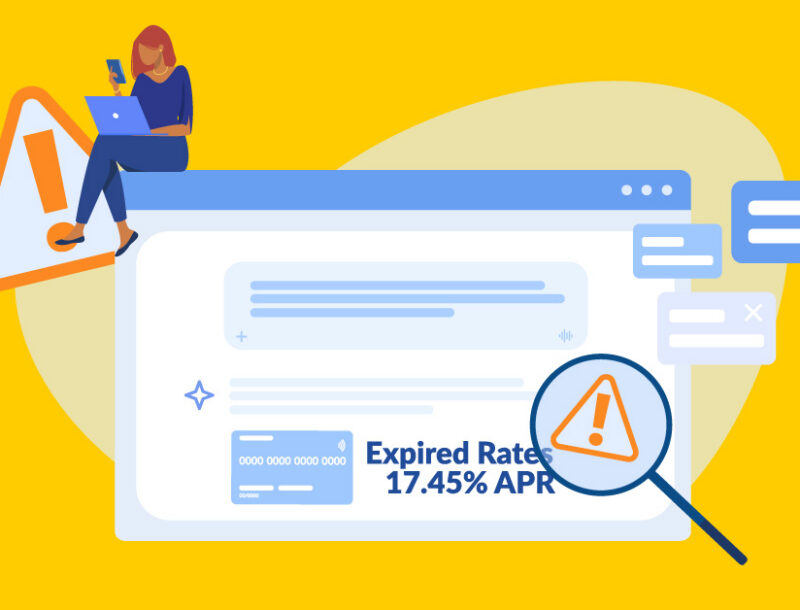
For financial institutions, this is a product accuracy and compliance problem, not only a reputation problem. When a consumer asks AI about your current credit card APR, mortgage rates, application process or card rewards, the answer may reflect an expired promotional rate, an old fee structure or last quarter’s benefits. The consumer can’t tell the information is stale. They act on it anyway, and the gap between what they were told and what you offer creates exposure.
Regulated brands feel this more. A single compliance misstep can show up in regulatory databases, news coverage and complaint forums, all of which can feed AI responses. A bank that fixed a past issue may find AI tools still surfacing the old story.
Where LLMs get financial products wrong
Models generate answers from patterns, not from a live check of your current terms. That leads to four predictable failure modes: hallucinated rates or fees, outdated terms, missing qualifiers like “terms apply,” and recommendations shaped by source prominence rather than neutral comparison.
How often it happens depends heavily on the task. On Vectara’s leaderboard, where models summarize a document they’re given, hallucination rates ranged from 1.8% to 24.2% across models as of May 2026. Without a source document, rates can run much higher: a 2024 Stanford study found earlier models hallucinated 69% to 88% of the time on specific questions about federal court cases. For a closer look at financial products, see How LLMs Represent Financial Products.
AI influence is growing faster than AI trust
Consumers aren’t handing financial decisions to AI. In TD’s March survey, only 18% said they would trust AI to make financial recommendations on its own. But AI is shaping the research. A September 2026 TD survey found 49% had used an AI assistant in the past year to research or make a personal financial decision, and 83% of those users checked the guidance with another source or professional.
That verification step is where your brand wins or loses. If a prospect checks an AI-quoted rate against your site and finds a different number, the mismatch reads as a trust problem, even though your institution did nothing wrong.
What AI pulls from to form brand opinions
Large language models and retrieval-based AI tools draw from a wide range of sources, including:
- News articles and press coverage, positive and negative
- Consumer review platforms such as Trustpilot, Google Reviews and the Better Business Bureau
- Regulatory filings, enforcement actions and government databases
- Social media and public forum discussions
- Your own website, including blog posts, landing pages and product descriptions
- Affiliate and partner pages that reference your products, rates or terms
- Comparison and analyst sites that mention your brand
Your brand narrative is no longer set by your owned pages alone. It’s co-authored by every piece of content about your company online.
How stale AI answers affect purchase behavior
In banking, the effect gets concrete fast. A customer shopping for a high-yield savings account asks an AI tool what your institution offers. If the model returns a rate from six months ago, before your last adjustment, that customer may assume your APY is uncompetitive. They never visit your site. They move on.
Loan products show the same problem. If a consumer asks about your mortgage or auto loan rates and gets a figure from an expired promotion, they’re deciding on bad information. If they reach your team and the real number is higher, that gap reads as a broken promise. Limited-time offers are especially vulnerable. A promotional CD rate or sign-up bonus can linger in AI responses long after the offer closes.
Generative AI and brand messaging compliance: a growing concern
As brands respond to the AI-driven shift in customer perception, many are accelerating their content production, personalizing messaging at scale and deploying AI tools in their own marketing and customer communications. This creates a new compliance challenge.
When AI generates customer-facing content, whether it is a chatbot response, a personalized email or a product recommendation, that content is still subject to the same regulatory standards as anything a human would write. Fair lending requirements, truth-in-advertising rules, financial product disclosures and consumer protection guidelines do not have an exemption for AI-generated copy.
The speed at which AI can generate and distribute content makes oversight more important, not less. A single prompt can produce thousands of variations of a message, each of which may interact differently with regulatory guardrails. Organizations that are not actively monitoring AI-generated communications are exposing themselves to compliance risk they may not even be aware of.
What AI is teaching customers to expect, and where brands get into trouble
Consumers who are used to getting instant, personalized, synthesized answers from AI tools bring those expectations into every brand interaction. They expect faster responses, more relevant communications and experiences that feel as seamless as their AI assistant does. When the brand experience falls short of that expectation, it creates a perception gap that is hard to close.
So brands are moving fast to meet that bar, deploying AI-powered customer experience tools, scaling personalized content and automating more of the communication journey. The problem is that speed without oversight creates its own set of risks. The compliance challenge is no longer only about reviewing what your team produces. AI can generate and distribute content at a scale and speed that no manual review process can match. Compliance teams need infrastructure that keeps pace: tools that can monitor accuracy and flag risk across AI-generated communications before regulators or customers find a problem.
The brands that get this right are not the ones moving fastest. They are the ones that have built monitoring and review into the process so that what their AI tools produce, at speed and at scale, still reflects accurate information, meets regulatory standards and gives customers a clear path to a human when the automated experience falls short. In regulated industries, that is not optional. It is what separates efficient from exposed.
Regulators expect accuracy, whoever wrote the answer
Regulators haven’t carved AI out of consumer protection law. The rules on deceptive claims, required disclosures and fair lending apply to what a consumer sees, whether a person or a model produced it. State regulators are also applying their own consumer protection frameworks, which can set a higher bar than the federal baseline. See Same Ad, Different State, Different Risk.
UDAAP analysis looks at what the consumer was told and whether it misled them. When inaccurate information about your product shapes a consumer’s decision, the question regulators are likely to ask isn’t who wrote it. It’s what you did to find and correct the sources behind it.
How banks can take back control of their AI narrative
You can’t edit an AI response. You can improve the information AI draws from and monitor what it says.
Start with your own content. AI tools that rely on public information favor clear, well-structured, current sources. A well-maintained site with accurate product, rate and terms content gives models better material.
Then fix the sources you don’t own. Affiliates, partners and third-party distributors are also AI sources. If they carry outdated rates, lapsed promotions or missing disclaimers, that bad data flows into AI responses too. PerformLine’s benchmark of leading U.S. banks found that 8% of discovered pages carried a potential compliance issue and that most issues lived outside owned channels. In one case, a third-party page still showed a 24.99% APR after the current rate had moved to 26.99%.
Get Ready to Stay Ready
Catch up on this Webinar Recap and the impact of cleaning up your ‘back-of-house’ before AI surfaces it for you.
Manage your reputation. Address old reviews, respond to complaints publicly and make sure your regulatory record reflects your current practices. Publishing updated, authoritative content is one of the most effective ways to shift an outdated AI narrative over time.
Monitor the responses, not only the mentions. AI visibility tools tell you whether and how often your brand appears in AI answers. They don’t tell you whether what’s said is accurate or compliant. We cover the difference in AI Visibility + Response Monitoring: Why You Need Both.
Here’s what that gap looks like. PerformLine ran a common consumer query through AI Response Monitor: the best credit cards for improving a low score. Gemini’s response about one issuer was “honestly, I rank them dead last, and I would avoid them like the plague.” A visibility tool would log a negative mention. Response monitoring also found three issues against the issuer’s affiliate guidelines underneath it: product benefits described without the required “terms apply” qualifiers, a shortened card name instead of the registered brand name, and product details paraphrased where exact approved wording was required.
Frequently asked questions about AI and brand perception
AI tools synthesize information from across the web. The answer a customer gets is shaped by everything public about your company, from news and reviews to regulatory history and partner pages. If any of that is outdated or misleading, AI may present it as current.
Yes. AI can surface outdated rates, draw wrong inferences from incomplete data or present resolved issues as current. Hallucination rates vary widely by model and task, from under 2% for the best models summarizing a provided document to far higher when models answer from memory. Brands can’t correct AI outputs directly, which makes source accuracy and monitoring more important.
It cuts both ways. Accurate, favorable AI answers can speed up trust. Inaccurate or negative ones create skepticism that’s hard to undo, especially when a customer checks an AI-quoted rate and finds a different number on your site.
It’s the picture of your company that AI tools build and pass on to users. It matters because 49% of consumers in a September 2026 TD survey had used an AI assistant to research or make a personal financial decision in the past year.
Publish clear, current content on your own site, make sure affiliates and partners carry accurate and compliant product information, stay active on review platforms and respond to complaints promptly. Because AI pulls from every available source, channel-wide accuracy matters as much as homepage accuracy.
Visibility tracking measures where and how often your brand appears in AI answers. Response monitoring evaluates whether those answers are accurate, on-brand and compliant with your guidelines and disclosures.
How PerformLine helps
PerformLine helps banks and financial institutions see and manage what AI and the wider web say about their products:
- AI Response Monitor pulls the full AI response, scores it against your brand guidelines and disclosures with a pass/fail result and documents it.
- Discovery finds unknown affiliate, partner and third-party pages that feed AI answers about your brand.
- Omni-Channel Monitoring keeps checking those sources across web, social, email, calls and messages.
AI doesn’t have to be a blind spot. With the right monitoring in place, it becomes another channel you can see, measure and correct.
For the full picture, download Marketing Compliance in the Age of AI, or listen to Episode 81 of the COMPLY Podcast. To see AI Response Monitor in action, request a demo.