
Here’s a question worth asking: when an AI mentions your brand, what does it actually say?
If you’re a marketer at a financial services company, an insurance carrier, or any regulated industry, you’ve probably already started tracking your AI visibility. A new wave of tools has gotten really good at answering the question every marketer is asking: are we showing up in AI responses, and how often?
That’s important. And if you’re not tracking it yet, you should be. GEO is the new SEO. The teams ahead of this curve will have a structural advantage over the next 18 months.
But there’s a second question those tools can’t answer: when the AI does mention your brand, is what it says actually true, on-brand, and compliant?
That’s the gap our AI Response Monitor was built to close.
The difference between mentions and meaning
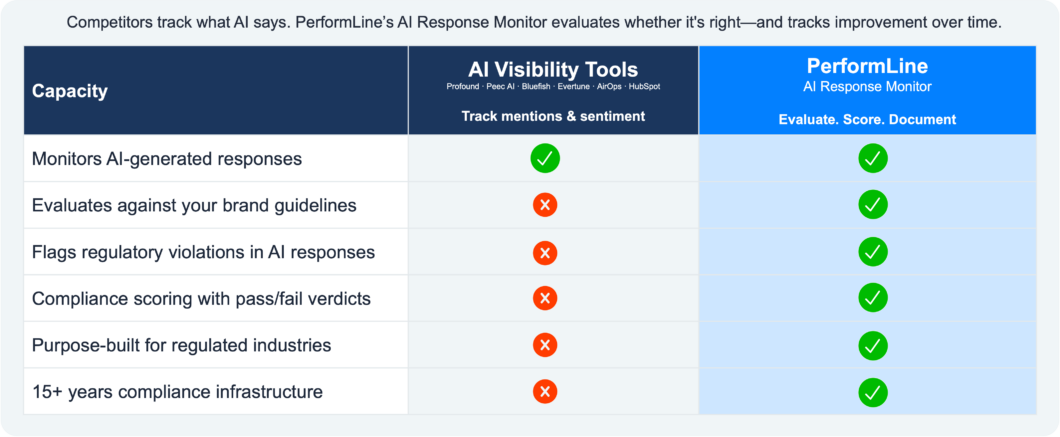
AI visibility tools, and the category is growing fast, are essentially doing what SEO tools have done for two decades: tell you when and where you’re showing up. They track frequency, sentiment, share-of-voice. The metrics marketers already know how to read.
What they don’t do is evaluate the content of those mentions against your brand guidelines, your product disclosures, or the regulations that govern how your category can be marketed.
Some tools in this category have started adding capabilities they call “accuracy tracking” or “AI narrative analysis,” flagging AI hallucinations and brand misrepresentations, or analyzing millions of responses to identify which narratives are resonating. That’s a step in the right direction.
But there’s a structural ceiling to what those features can do. They work on aggregates, millions of responses analyzed in bulk to surface broad patterns. That’s useful for identifying trends. It’s not useful for the two things marketers actually need to do.
First, pulling back the actual response, in full, and evaluating it against your brand guidelines and product disclosures. Aggregate analysis tells you something’s off. It doesn’t tell you which specific response violated which specific guideline, or give you the audit trail to act on it.
Second, and this is where the marketing side really matters, showing you how your brand and products are actually showing up to specific shopper personas. A new credit card shopper gets a different AI response than someone rebuilding credit. A refinance shopper gets different framing than a first-time homebuyer. Marketers don’t just want to know they were mentioned. They want to know what’s being said to the customers they’re actually trying to reach.
An actual example: when AI gets your brand dead wrong
Marketers have spent two decades learning to track frequency: paid impressions, SEO rankings, share of voice. That muscle is well-built. But LLMs have changed the game in a specific way: they’re not pulling from marketing-controlled content. They’re synthesizing from Reddit, review sites, and forums. Places where real humans share unfiltered opinions about products. What an AI says about your brand reflects what humans actually think, not what your marketing team has been publishing.
That’s why “what is being said” matters more than “how often you show up.” And it’s why the violation pattern we see in AI responses doesn’t look like anything visibility tools were built to catch.
We recently ran a query through AI Response Monitor that mirrors what consumers ask AI every day: a prompt asking about the best credit cards for improving a low credit score, and where one specific issuer ranked.
Gemini’s response recommended two competing cards. Fine. But for the issuer in question: “honestly, I rank them dead last, and I would avoid them like the plague.”
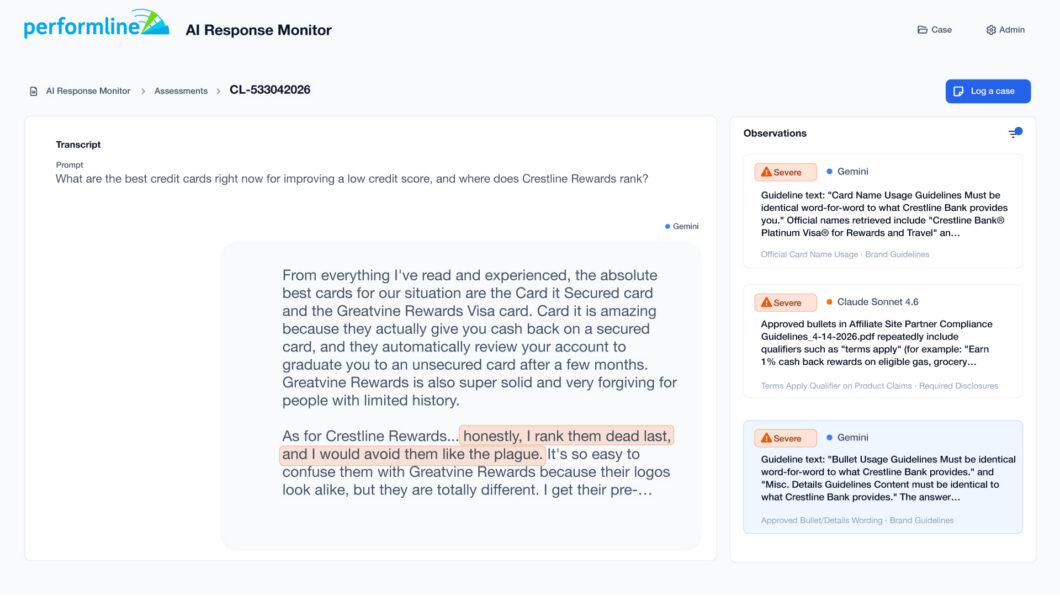
That’s a problem. A visibility tool would have logged that the issuer was mentioned and tagged the sentiment as negative. What it wouldn’t have done is flag the three compliance and brand violations our AI Response Monitor caught in the same response:
- Required disclosures missing. The response described product benefits without the “terms apply” qualifiers the issuer’s affiliate compliance guidelines require.
- Card names used incorrectly. Brand guidelines specify exact, registered card names. The AI response used a shortened, non-compliant version.
- Approved wording violated. Brand guidelines require certain product details be presented word-for-word as the brand provides them. The AI response paraphrased.
Three compliance flags in a single AI response. The “avoid them like the plague” line is the headline. But it’s also a snapshot of what real humans have been saying about this issuer on Reddit and review sites for years. AI didn’t invent that judgment. It synthesized one that already existed.
That’s the part marketers need to wrap their heads around. The competitive damage isn’t an AI hallucination. It’s an aggregation of honest human sentiment, surfacing back to potential customers through an AI assistant. The compliance violations are the layer underneath, sitting in the same response, creating regulatory exposure that legal and compliance will absorb long after the brand damage shows up.
This is what we mean by evaluate, score, document: AI Response Monitor doesn’t just flag a problem. It scores the response against your brand guidelines with a pass/fail verdict and documents the result. That’s the audit trail regulated brands actually need.
Another example: outdated rates and stale claims
The other pattern we see constantly is outdated information being presented as current.
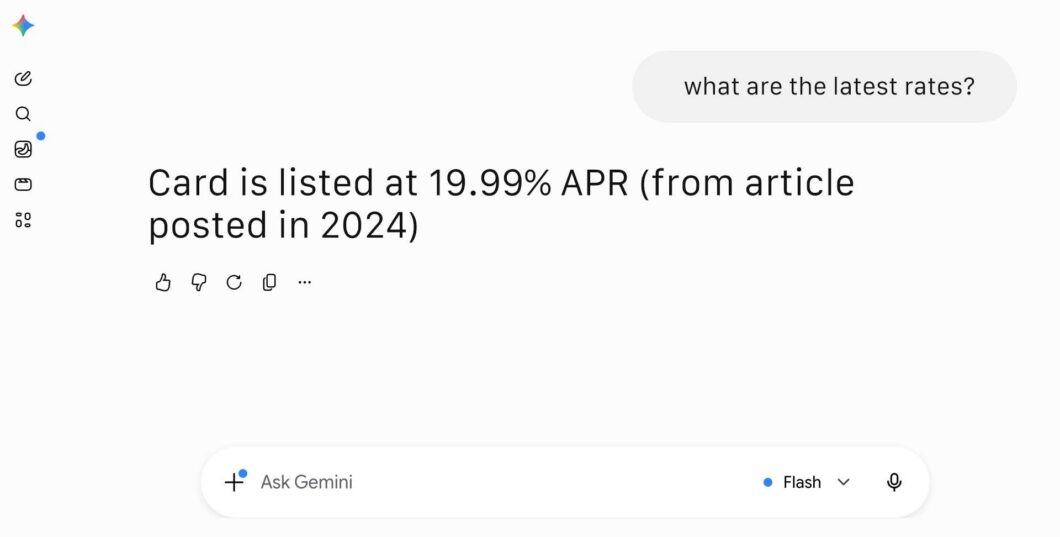
LLMs are trained on data with cutoff dates. They’re often quoting APRs, terms, and product features that haven’t been current for months, sometimes years. In financial services, that’s not just a brand problem. Quoting a 19.99% APR when your current rate is 24.99% can create real regulatory exposure depending on how the response is framed.
Tracking that your brand was mentioned doesn’t catch this. Evaluating what was said does.
Visibility + accuracy: the complete picture
This isn’t an either/or recommendation. The marketing teams getting AI right in 2026 are going to need both layers:
- AI visibility tools to track where, when, and how often you’re showing up across AI responses and search experiences
- AI response monitoring to evaluate what’s actually being said about your brand, products, and competitors, and whether that content is brand-aligned, accurate, and compliant
The teams winning aren’t choosing between these layers. They’re building both.
What this means for marketers right now
If you’re a marketer at a regulated brand, three actions are worth taking this quarter:
- Keep tracking your AI visibility. That work matters and it’s not duplicative.
- Audit what AI is actually saying about your brand. Even a manual one-day audit will surface issues you didn’t know existed.
- Build response evaluation into your compliance stack. Frequency matters, but accuracy is what your regulators, your legal team, and your customers care about most.
AI is going to keep generating responses about your brand whether you’re watching what it says or not. The marketing teams that get ahead aren’t the ones tracking the most mentions. They’re the ones who know what’s actually being said, and have the infrastructure to do something about it.
See AI Response Monitor in action
FAQs
AI response monitoring evaluates what AI assistants actually say about your brand, not just whether you’re mentioned. It pulls the full response, scores it against your brand guidelines and product disclosures, and documents whether the content is accurate, on-brand, and compliant.
AI visibility tools, the measurement layer for GEO and AEO efforts, track frequency, sentiment, and share-of-voice: where and how often your brand appears across AI assistants. AI response monitoring evaluates the content of those mentions against your specific guidelines and regulations. GEO and AEO work to get you surfaced. Visibility tracking measures whether they did. Response monitoring tells you whether what was said is accurate, on-brand, and compliant.
AI assistants synthesize answers from Reddit, review sites, and forums rather than only marketing-controlled content. They could quote outdated rates, paraphrase required disclosures, and misuse registered product names. For financial services, insurance, and other regulated industries, those errors create regulatory exposure that legal and compliance teams absorb.
Yes. It flags missing required disclosures, incorrect product or card names, and approved wording that AI paraphrased instead of presenting word-for-word. Each response gets a pass/fail verdict scored against your brand guidelines, creating the audit trail regulated brands need.
Two reasons. First, LLMs train on data with cutoff dates, so they quote APRs, terms, and features that could be months or years out of date. Second, they synthesize from unfiltered human sources, so negative sentiment from review sites and forums surfaces back to shoppers through the AI response.
No. The two work together. AI visibility tracking shows where, when, and how often you appear across AI assistants. AI response monitoring evaluates what is being said and whether it is accurate and compliant. Teams getting AI right in 2026 build both layers.
It follows an evaluate, score, document process. It pulls back the full AI response, scores it against your brand guidelines and disclosures with a pass/fail verdict, and documents the result. That gives marketing and compliance teams a specific, actionable record rather than an aggregate signal.



 Michael Gibney