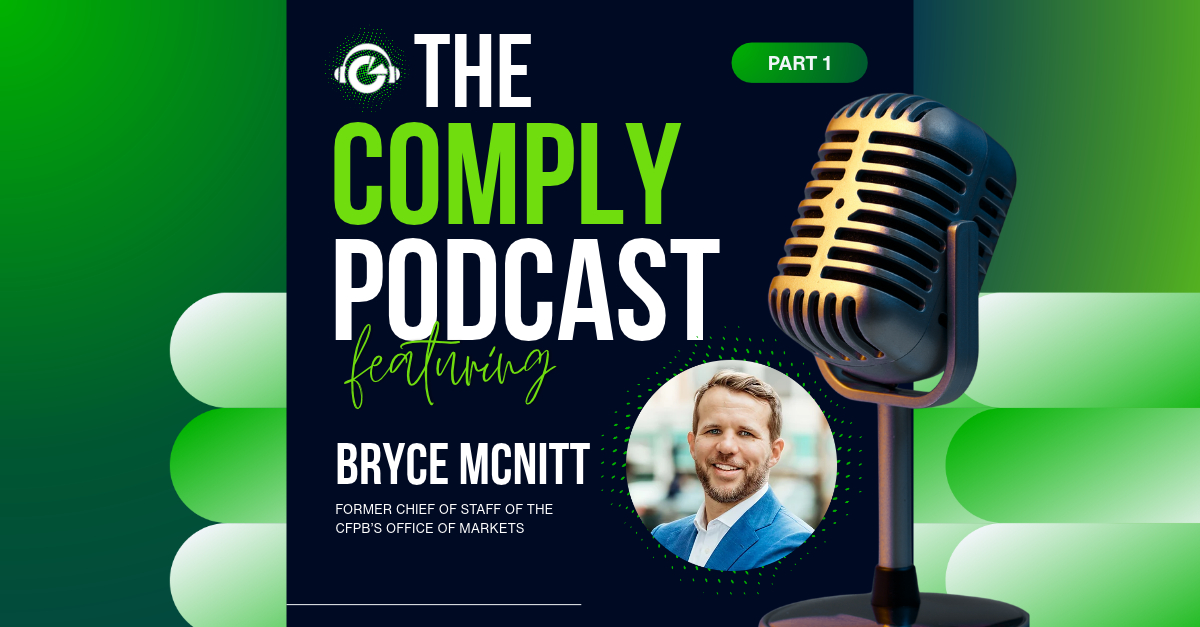
As federal consumer finance enforcement pulls back, state regulators are stepping in. In Part 1 of this two-part episode of COMPLY, Bryce McNitt, director of state government affairs at PayActiv and former chief of staff at the CFPB’s Office of Markets, joins PerformLine’s Ashley Cianci. They discuss how states are filling the gap and what that means for compliance teams planning for 2027.
Key Takeaways
- Why junk fees and affordability are back on the agenda in states including New Jersey and California, and in New York City
- How states are using multistate actions, like the 46-state settlement with Block, to fill the federal enforcement gap
- What the DIDMCA opt-out fight and the end of Chevron deference mean for federal preemption
- How regulators are applying longstanding lending laws to innovative financial products
- Why the CFPB’s decision to stop publishing complaint narratives matters for compliance teams
- How former CFPB staff are shaping consumer protection at the state level and in private practice
Show Notes:
- Access the full webinar: https://events.performline.com/industry-regulatory-update-for-compliance-risk
- Connect with Bryce McNitt on LinkedIn: https://www.linkedin.com/in/brycemcnitt/
- Connect with Ashley Cianci on LinkedIn: https://www.linkedin.com/in/ashley-cianci/
- Subscribe to PerformLine to stay connected to resources and updates: https://lp.performline.com/subscribe-to-performline
Subscribe to COMPLY: The Marketing Compliance Podcast
About COMPLY: The Marketing Compliance Podcast
The state of marketing compliance and regulation is evolving faster than ever. On the COMPLY Podcast, we sit down with the biggest names in marketing, compliance, regulations, and innovation as they share their playbooks to help you take your compliance practice to the next level.
This podcast is for informational and educational purposes only and does not constitute legal advice; consult your own compliance or legal counsel.
Episode Transcript:
Ashley Cianci:
Hey there, COMPLY Podcast listeners, and welcome to this week’s episode. I’m Ashley Cianci your host of the COMPLY Podcast. Today’s episode is a special one. Earlier this week, we hosted a live webinar with Bryce McNitt, former Chief of Staff of the CFPB’s Office of Markets. That’s a team that tracks where risk is building across lending, payments, deposits, and emerging products.
Bryce is now director of state government affairs at PayActiv. So he’s seen consumer finance regulation from both sides: the federal agency that set the agenda for a decade, and the states that are now taking it over. The conversation was so packed that we split it into two episodes. In part one, Bryce explains why federal regulation didn’t make the risk go away. It moved it. We’ll cover junk fees, making a comeback at the state level, state AGs stepping into the enforcement gap, why preemption isn’t the safe bet it used to be and why he calls it the private CFPB. So without further ado, here’s Bryce.
Bryce McNitt:
Thanks so much, Ashley. It was a great introduction. I appreciate that. And like Ashley said, it is a really interesting time. I was in CFPB for a long time as a leader in the Office of Markets, as she said. And I think I’ll just pick up the story from the 2024 election and how things changed and then what we’ve seen since then.
So, you know, being in CFPB under the Biden administration, there was a lot of emphasis on affordability, things like junk fees. That was a big theme throughout that entire administration. Right after the election of 2024, those terms, those phrases completely disappeared in a sort of jarring fashion. And it was almost like they had never occurred. And so, yeah, the words like junk fees had disappeared. And of course, there was a big deregulatory push across the board throughout all of government under the Trump administration, which wasn’t much of a surprise.
And I think we all know sort of the void that that has left. And really what’s interesting, I think, for industry is this sort of gathering momentum of a counter reaction that’s emerged at the state level. And so one great sort of macro lens to start with, and then we’ll kind of zoom in, is the return of Biden-era policies at the state and local level over the last 18-ish months. And they really kind of took shape here in 2026. And of course that dovetails in perfectly with the midterms that we just had, because I think it’s all part of the same trend. And so we’ll go through all of that as we go through the presentation.
Junk fees made a return this year as part of the affordability agenda that has been driving politics now throughout at least 2026. New Jersey is a great example of this return. So the New Jersey’s attorney general and Division of Consumer Affairs issued a comprehensive enforcement statement signaling an aggressive enforcement posture toward junk fees under the New Jersey Consumer Fraud Act. And my understanding is that they’re also doing a full audit of all business practices of supervised entities there and will be moving aggressively on anything that they believe to be a true junk fee in financial services.
So it’s just a great example of how things have started to come back all the way back around, and in a very short period of time. I mean, 2024 was not that long ago, and we’ve already seen some of these policies return with some force, but just in lots of different places.
Other examples: California passed its No Hidden Fees Act back in 2024. Similar rules, laws have been passed in Minnesota, Connecticut, Colorado, Oregon, Virginia, Massachusetts. Even at the municipal level, actors have begun to be more assertive. New York City passed its hotel pricing, all-in hotel pricing regulation back in 2024. And then they’ve introduced this year an industry-agnostic version of that, which would require all-in pricing for all products. And that law has very rigorous recordkeeping requirements, which would require tracking every fee and its purpose. So the nature, the purpose, the amount, and the refundability of every fee.
So you know, New York is its own, is its own beast. But that just shows, like, where the trend might be over time as affordability continues to be a big focus for this growing force of Democratic leaders at the state level. And as we’ll talk about the election, there’s a lot more of them coming into office very, very soon.
So downstream of regulation is enforcement. And we’ve started to see the states pick up the enforcement activity that the federal regulators decided to leave off for now. There’s been little enforcement at the federal level. There were some big ones recently, mostly focused on, I think, major banks, mostly related to AML, anti-money laundering, but very little of the wave of consent orders we saw in industry from, like, 2020 to 2024 under the Chopra CFPB and FDIC and FTC. Like, all the regulators were really pushing a lot of consent orders related to UDAPs and other practices. Those have gone away, and we’ve seen state and local enforcement leaders move in to fill that gap.
So one, I think a couple of good examples of this: Earlier in the year, a collection of states led in part by the Pennsylvania AG’s office and ex-CFPB enforcement attorney Nick Smith, they filed suit against OneMain Financial stemming from issues over UDAAPs, so unfair, deceptive, abusive acts of practices. They used UDAAPs in the Consumer Protection Act, the federal law, as well as New York’s executive and general business law, Pennsylvania’s consumer protection law, and additional laws in Colorado, Maryland, Nevada, New Jersey, and Washington. So a whole buffet of different laws and regulations being used in this case.
The case was largely focused on marketing practices, add-on products, like gap insurance, things like that, for OneMain’s lending products, but it wasn’t really as focused on the actual lending products itself. And it was also modeled after a CFPB suit against the same company under the Biden CFPB. And so it’s kind of an example of the states sort of setting the tone for what they want to focus on. Basically they’re saying, “We see that the CFPB is not doing anything, but we’re not okay standing by and letting companies do whatever they want.” Not that, not necessarily that they are doing that, but they want to send a powerful message that consumer protection enforcement will continue regardless of what the federal government is doing. And so that was a great example.
There was another one in the middle of this year: 46 states settled with Block over customer service failures and deceptive marketing practices, such as leading customers to believe that the Cash App was a bank and had FDIC protection. At least that was the accusation in the settlement.
The interesting part about this one is it explicitly says that satisfying the settlement with the states means paying the fine stemming from the 2020, 2025 settlement with CFPB. Block also had a settlement with CFPB. And so the settlement with the states says if you pay that fine, you’re essentially good on this settlement as well. And then there was a small, well, not very small, but smaller additional fine as part of the state settlement as well.
And so again, this is like an explicit case of a very bipartisan group of states. Forty-six, you can’t get much more bipartisan than that. There’s almost no one not participating there, saying, “We want industry to be accountable during this era of reduced federal enforcement.”
I want to talk about preemption a little bit. Kind of dovetailing with this decrease in federal activity, increase in state activity, it’s kind of brought a battle over preemption, like who’s in charge, to a head. And a great case study of the battle over preemption that has emerged here is the Depository Institutions Deregulation and Monetary Control Act of 1980, better known as DIDMCA. This is essentially a law that was passed in 1980 that allows state-chartered banks to better compete with nationally chartered banks by allowing them to export their home states’ allowable interest rates and ignore the usury caps of the states where the borrower lives.
So it’s been around for a long time. There is an opt-out clause in the law, and states have opted out, in over time over those 40-odd years. But recently more states have started to opt out with a novel interpretation of what opting out means. Essentially saying, and Colorado’s the best example of this, saying that they’re opting out, and then if a loan is made, let’s say, by a bank in Alabama, where there’s no usury cap, and the consumer lives in Colorado, that that state-chartered bank has to abide by the usury cap of Colorado, which is 36%. So it’s essentially saying that the loan is made wherever the consumer lives, which is not the way things have been interpreted in the past.
So that opt-out obviously made its way very quickly into the courts. It is now with an en banc review in the 10th circuit court. Here, in Colorado, that’s where I’m sitting today, the really interesting part here is, I mean, it’s a federal law. The OCC has already said that they strongly believe that there’s federal preemption here and that there shouldn’t be state discretion in terms of how they interpret the statutes. But there was the Loper Bright decision at the Supreme Court recently, a year or two ago, that overturned Chevron deference, which was a long-standing precedent in the country that federal agencies had the final say in how they interpreted statute in when they implemented regulation. And courts, federal courts would defer to them.
So that Loper Bright decision means now that there’s no deference and that the courts are the ultimate arbiter of how statute should be interpreted, and regulation. So we have this interesting dynamic where the OCC is just and other prudential regulators are just a party to a case. They’re filing an amicus brief, but they don’t have the deference anymore.
And this was, you know, Loper Bright overturning Chevron deference, I think everyone could safely agree that that was a conservative initiative. But now that conservatives have control over the executive branch, they’re kind of the chickens are coming home to roost here, because they don’t have control over their own priorities.
And so this is a great example here where preemption has become much more complicated. It’s not as cut-and-dried as it was for the last, you know, many decades. And there’s a lot more uncertainty, I think, operational uncertainty for companies going forward.
And so, you know, this new regime means that when regulations are passed, other parties, counterparties, whether they be advocates or industry, will search for the most sympathetic federal court that they can find. So that might be Texas for industry and California for advocates to try to get regulations overturned. It’s kind of gonna be a mess, I think, for a long, long time, until maybe we go back to the way things were. I really don’t know how that will resolve.
But essentially what it means now for industry is that even if there is a clear federal rule related to an industry, you might not get finality on that for many, many years as it winds through the courts. And you’re gonna have to make a risk calculated decision on whether you want to rely on preemption or you want to comply with 20 or 30 or 40 different state laws when you’re deploying your products out to consumers across the country.
So another part of this trend and the shift to the states filling the void here is their application of longstanding lending laws to innovative financial products. One of the themes here over the last few years has been state, and well, federal under the Biden administration, but state enforcement actions asking, “Is this just a loan by another name?”
And so you have an innovative product that says it’s not a loan. They’re using established law to say, “Well, we think it’s actually a loan by another name.” That allows regulators to not have to rely on new statutes being passed and gives them a lot more discretion. So an example of this would be consumer leasing companies. Regulators have asserted that they are just actually lenders and should be held to usury caps in the states where they operate. And this kind of refitting of the law to adjust for a novel product is just going to continue to create operational uncertainty.
So you’ve seen some of these companies and industries try to pivot to the legislative channel and try to get more clear statutes passed for innovative products that gives them the certainty they need to operate in the future. That’s gonna be a trend, I think, that plays out for a long, long time here in the states, and it’s very, very active.
The same dynamic is cropping up with algorithmic pricing. The technology is new, but regulators can apply longstanding principles concerning discrimination, deception, fairness, pricing and disclosure rules to kind of grapple with this new technology-based product. Okay.
And then I think this dovetails very nicely with complaints and what’s happened with complaints. So usually, you know, I think of complaints as regulatory intelligence, right? So what are the trends with complaints? What is the volume by product set, by industry? And what is your company getting? But I think you need both pieces.
And the CFPB recently stopped publishing consumer complaint narratives publicly. And I would say it’s safe to assume that, you know, industry had asked for these to stop being published because many of them are erroneous or not worded carefully, and it’s hard to tell what really happened. Some of them might malign the reputation of a company. But I would also argue that there’s probably zero people sitting on the bus reading consumer complaints on their phone while in their morning commute.
So I think this really was a tool for industry and advocates and consumer protection advocates to get a grasp on what was happening in industry and where harm was cropping up. And so now companies will not be able to see the complaints against their competitors or just the complaints against their industry, product set or their niche. They’ll just see the complaints for their own company. And so they’ll have a harder time, I believe, in getting a sense of where regulators are gonna go with their future activities, because it’s very heavily based on complaint volumes. That is one of the most fundamental guides, guide stars, for regulators. Certainly within CFPB that was the case, and that’s the case at the state level as well.
So I would not be surprised, and maybe it will be a good thing for industry and for everyone, if those complaints start to be published again, if not in the next two years, than in 2029.
So just kind of, like, wrap up this whole trend of, you know, federal agencies leaving sort of a big gap and states filling it up is what I call CFPB Reform and the Great Scattering. Great Scattering is a very niche sci-fi novel reference that I’m sure no one will get, but I’m excited to put that into a slide.
And so, you know, we kind of talked about it. There’s been a lot of retrenchment at CFPB. Very little has been put forward to fill that void, so there’s more uncertainty. And also at the same time, though, because of the difficult time that everyone had at CFPB, which included me, I was there for that turnover, which was rocky, there’s been a huge diaspora of talent, very high-level talent that has gone across the entire country.
So over 700 staff members have left CFPB since 2025. And they have landed in senior leadership roles in New York, Pennsylvania, California, Vermont, New Jersey, other places. They’ve started boutique consumer protection firms as well to expand private right of action cases.
And so it’s created what some industry observers have called the “private CFPB,” which is a sort of a diffuse network of consumer protection advocates, lawyers, and regulators that are really pushing policy at a national level through the states and municipalities, and has become quite effective, I would say, in 2026. And I would argue that it’s part of the same trend that we saw play out in the midterms as well. This might really become the zeitgeist here over the next two years after the blowout in the midterms. So it’s something to watch.
You know, we’re in an era in this country where we’re gonna get a lot of whiplash. Every two years might see a new blowout election. It’s a hard time in terms of where the country’s finances are, and lawmakers have very hard problems to solve. And that often leads to dissatisfied voters. So it’s hard to say how long this trend will go and if we’ll whip back in the other direction, but that’s where we are right now.
Ashley Cianci:
Thanks so much for listening to this week’s COMPLY Podcast. That wraps up part one of Bryce McNitt’s webinar. The big takeaway: the federal pullback created a vacuum and the states are filling it fast. More AGs are enforcing, more state fee laws are on the books, and a network of former CFPB talent is pushing it all forward. If your compliance plan still assumes Washington sets the pace, now’s the time to revisit.
In part two, Bryce turns to AI. He covers how states are regulating it, who’s liable when an AI agent goes off script, what last week’s midterms mean for 2027 and beyond, and why every decision you make right now could be reviewed in 2029. Don’t miss it. You can watch the full webinar on demand at PerformLine.com. Thank you so much for listening to the COMPLY podcast, and we’ll see you next time.
You can follow PerformLine on LinkedIn for news and content in between episodes. And if this episode sparks something, a question, a disagreement, a topic you want us to dig into. Reach out at performline.com, or you can connect with me personally on LinkedIn.