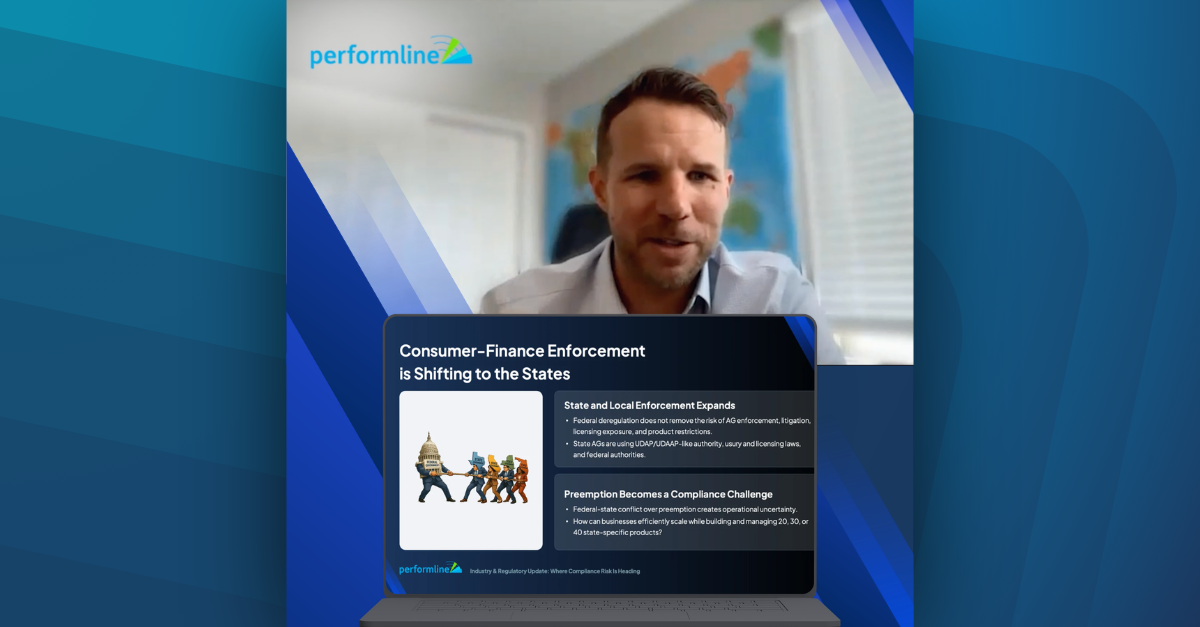
When the federal government stepped back from consumer finance enforcement after the 2024 election, a lot of compliance teams exhaled. That was a mistake. The risk didn’t go away. It moved to state capitals, and it’s moving fast.
That was the core message from our recent webinar, Industry & Regulatory Update: Where Compliance Risk Is Heading, with Bryce McNitt. Bryce was Chief of Staff for the CFPB’s Office of Markets, the team that tracks where risk is building across lending, payments, deposits and emerging products. Today he’s Director of State Government Affairs at PayActiv. Few people have watched consumer finance regulation from both sides: the federal agency that set the agenda for a decade, and the states now taking it over.
Here’s what he sees coming, and what it means for your 2027 compliance plan.
The states are filling the enforcement gap
Under the Biden administration, “junk fees” and affordability were constant themes. After the 2024 election, those words disappeared from the federal vocabulary almost overnight. Federal enforcement has slowed to a trickle, outside a handful of large AML actions.
The states noticed. Junk fees are back as a state priority:
- New Jersey: The Attorney General and Division of Consumer Affairs issued an enforcement statement signaling an aggressive posture on junk fees under the NJ Consumer Fraud Act.
- Hidden fee laws: California, Minnesota, Connecticut, Colorado, Oregon, Virginia and Massachusetts have all passed them.
- New York City: A proposed industry-agnostic all-in pricing rule would require tracking the nature, purpose, amount and refundability of every fee.
State AGs are also picking up the cases federal regulators left behind. A multistate group led in part by Pennsylvania sued OneMain Financial over UDAAP violations tied to add-on products like GAP insurance. The case was modeled on an earlier CFPB suit against the same company. Separately, 46 states settled with Block over customer service failures and deceptive marketing, including leading customers to believe Cash App was a bank with FDIC protection.
“46, you can’t get much more bipartisan,” Bryce noted. The message is clear: consumer protection enforcement continues, whatever Washington does.
There’s a talent story here too. More than 700 staff have left the CFPB since 2025. Many now hold senior roles in state agencies in New York, Pennsylvania, California, Vermont and New Jersey, or have started consumer protection firms. Industry observers call it the “private CFPB”: a diffuse network of regulators, lawyers and advocates pushing national policy through the states.
One more blind spot: the CFPB stopped publishing consumer complaint narratives. Companies can now see only their own complaints, not their competitors’ or their category’s. That makes it harder to see where regulators will look next, because complaint volume is one of the main signals they follow.
Preemption is no longer a safe bet
For decades, federal preemption gave national players a clear rulebook. That certainty is eroding.
Take the Depository Institutions Deregulation and Monetary Control Act of 1980 (DIDMCA). It lets state-chartered banks export their home state’s interest rates, but states can opt out. Colorado opted out with a new reading: the loan is made where the consumer lives. So a bank in a state with no usury cap would be held to Colorado’s 36% cap when lending to a Colorado resident. The case is now on en banc review in the 10th Circuit.
The OCC says federal preemption applies. But after the Supreme Court’s Loper Bright decision ended Chevron deference, agencies no longer get the final word on how statutes are read. The OCC is now just another party filing an amicus brief.
The result is years of uncertainty. Expect both sides to shop for friendly courts. As Bryce put it, even a clear federal rule may not bring finality “for many, many years.” Companies must make a risk call: rely on preemption, or comply with 20, 30 or 40 different state laws.
Regulators are also stretching old laws to fit new products. They ask whether an innovative product is “just a loan by another name,” as they have with consumer leasing. The same approach is coming for algorithmic pricing, through existing rules on discrimination, deception, fairness and disclosure.
AI rules are being written state by state
The federal government has stayed out of AI regulation by design. The states haven’t waited. Even red states like Utah and Texas are leading. Bryce sees three types of laws emerging:
- Consequential decision laws. Colorado’s automated decision-making technology (ADMT) law covers decisions affecting access to education, employment, financial services, insurance, healthcare and essential government services. Enforcement is expected to begin in early 2027. Deployers, including banks and fintechs using AI for loan approvals or risk pricing, must disclose AI use at the point of interaction, explain its role within 30 days of an adverse outcome, and offer correction and human review.
- Use-case laws. These regulate specific uses of AI rather than AI in general. Utah is the leading example, with a heavy focus on disclosure and user safety.
- Authenticity and transparency laws. These target deepfakes and scams.
The biggest gap is consumer use of AI. What happens when an LLM steers a consumer toward a product because the provider paid for placement? Or leads them into a flow built on dark patterns? No state has written rules for that yet.
Until one does, regulators will lean on what already exists. Bryce’s advice: keep the CFPB’s 2023 policy statement on abusiveness close. “You should read it at night before bed and keep it on your nightstand.” It’s the most restrictive interpretation of abusiveness out there, and state regulators use it as a guide.
Agentic AI is even further out. Rohit Chopra, now leading California’s Business and Consumer Services Agency, has floated a theory of liability. If an agent strays from a consumer’s instructions, the developer is liable. If a financial institution accepts instructions that don’t reasonably look like the consumer’s, the institution is liable. That second idea is fuzzy, and it could create something close to a fiduciary duty. It’s only a theory for now, but it shows where the thinking is headed.
The midterms speed everything up, and 2029 is the date to watch
This month’s midterms reshaped the map. Democrats took the House and Senate. Six governorships flipped, giving Democrats about 30. Four to five AG offices flipped, including Texas, Kansas, Iowa and Georgia. Twelve state legislative chambers turned blue, and none turned red.
More states can now pass consumer protection laws easily, so Bryce expects state activity to keep growing. Federal priorities are shifting too. Maxine Waters, who is seeking to lead the House Financial Services Committee, listed junk fees and protecting the CFPB among her top priorities.
At the CFPB, a new director may have only two years before the next presidential election. Bryce’s advice is to plan for a return to a Chopra-style CFPB in 2029. He puts the odds at “at least 50/50.”
That’s where look-back periods come in. They run at least two years, and longer for fair lending and ECOA. “Everything happening right now is gonna be up for review in 2029,” Bryce said. Decisions made in today’s deregulatory window could be judged by a very different set of regulators.
What this means for your 2027 plan
The federal pullback changed who is enforcing, not whether enforcement happens. A few steps to consider now:
- Map your state exposure. Look at where you market, not just where you’re chartered. Hidden-fee laws, AI laws and AG priorities follow the consumer.
- Make the preemption call deliberately. If you rely on it, document why, and track the cases that could change the answer.
- Review against the strictest standard in play. For fees, that’s the all-in pricing laws. For abusiveness, it’s the CFPB’s 2023 policy statement.
- Keep records as if they’ll be read in 2029. Look-back periods mean decisions made today may be reviewed by a very different set of regulators.
Want the full conversation? Watch Industry & Regulatory Update: Where Compliance Risk Is Heading on demand.

 PerformLine