Your customers are forming opinions about your brand before they ever land on your website. They are asking AI. They are getting answers. And in many cases, they are making decisions based on what an AI tool tells them, not what your marketing team crafted.
This is not a future problem. It is happening right now, across every industry, and the brands that understand what is driving this shift will be better positioned to protect their reputation, maintain customer trust, and stay ahead of the compliance and messaging challenges that come with it.
How AI Is Changing the Customer Research Journey
Not long ago, a consumer who wanted to evaluate a brand would follow a fairly predictable path. They might search Google, scroll through a few blog posts, check some reviews, and eventually land on your site. The company had a reasonable amount of control over the narrative at each of those touchpoints.
That path has fundamentally changed. Shopping-related generative AI use grew by 35% from February to November 2025 alone, according to research from BCG. Consumers are now asking AI assistants questions that used to be answered by your sales team, your FAQ page, or your customer reviews. And the AI is answering them, whether or not your brand has any input into what it says.
What this means in practice is that a potential customer might ask ChatGPT or another AI LLM, “Is [your company] trustworthy?” or “What do people say about [your product]?” and get a synthesized response drawn from whatever data the model has access to. Your press releases, your reviews, your social media presence, your regulatory history, all of it becomes raw material.
The AI Brand Perception Problem: What Customers Believe vs. What Is True
Here is where it gets complicated. AI-generated responses are not always accurate, and they are rarely neutral. They reflect the data they were trained on, the sources they can access, and the way questions are framed. A customer who asks an AI about your brand might get an answer that is outdated, incomplete, or drawn from a negative news story that has since been resolved.
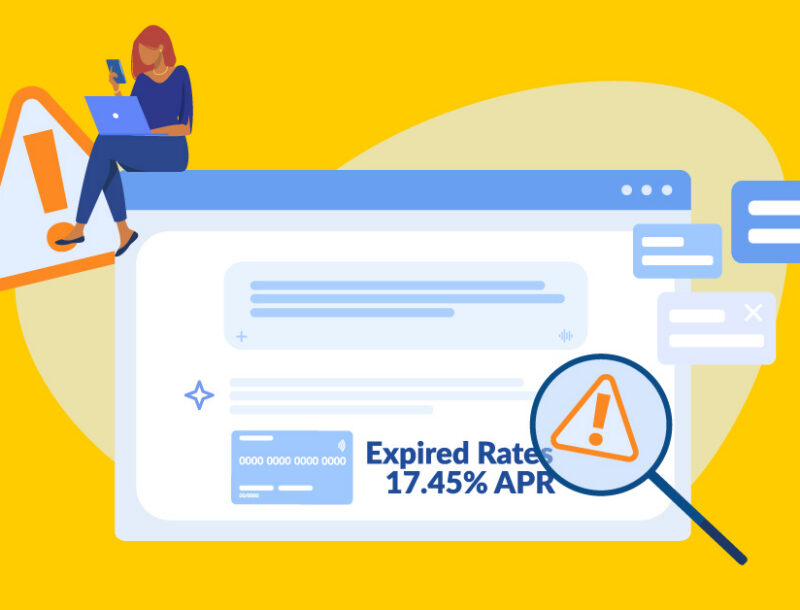
This creates a genuine brand perception problem. If a customer believes something about your company because an AI told them so, correcting that belief requires more than updating your homepage. It requires thinking carefully about what information is out there, how it is structured, and whether it accurately represents who you are today. But for financial institutions, this is not just a reputation problem. It is a product accuracy and compliance problem. When a consumer asks AI about your current credit card APR, your mortgage rates, your application process, or your card rewards and perks, they are getting an answer based on whatever data the model has access to. That data may be a year old. It may reflect a promotional rate that has since expired, a fee structure that has changed, or a benefits package that was updated last quarter. The consumer has no way to know the information is stale. They make decisions based on it anyway. And when what they were told does not match what your institution actually offers, the gap creates a compliance exposure, not just a bad customer experience.
The issue is particularly acute in regulated industries. Financial services, mortgage lending, insurance, healthcare, and consumer finance brands operate in spaces where a single compliance misstep can show up in regulatory databases, news coverage, or consumer complaint forums, all of which can become AI training data. A brand that has cleaned up a past issue may find that AI tools are still surfacing the old narrative.
AI Recommendations and Consumer Trust: A New Kind of Social Proof
Trust has always been the currency of brand relationships. But AI is rewriting how trust gets established. Traditionally, trust was built through word of mouth, reviews, advertising, and direct customer experience. AI introduces a new layer: algorithmic credibility.
When an AI recommends your product or describes your brand in positive terms, many consumers treat that as an unbiased endorsement. Research consistently shows that consumers perceive AI-generated responses as more objective than branded marketing content. That perception is not always accurate, but it is powerful, and it shapes purchasing decisions.
On the flip side, when AI returns negative or ambiguous information about a brand, consumers apply that same trust to the negative result. A poorly sourced, outdated, or simply wrong AI response can carry as much weight as a real customer review, sometimes more.
What AI Is Actually Pulling From to Form Brand Opinions
Understanding how AI forms brand impressions requires understanding what it draws from. Large language models and retrieval-augmented AI tools pull from a wide range of sources, including:
- News articles and press coverage, both positive and negative
- Consumer review platforms such as Trustpilot, Google Reviews, and the Better Business Bureau
- Regulatory filings, enforcement actions, and government databases
- Social media conversations and public forum discussions
- Your own website content, including blog posts, landing pages, and product descriptions
- Affiliate and partner pages that reference your products, rates, or terms
- Third-party analyst or comparison sites that mention your brand
The implication is clear: your brand narrative is no longer solely determined by your owned and operated pages. It is co-authored by every piece of content that exists about your company online. That includes the regulatory history you would rather leave in the past, and the review from a frustrated customer two years ago.
How AI Brand Sentiment Affects Customer Perception and Purchase Behavior
The downstream effect on purchase behavior is significant, and in banking it gets concrete fast. A customer shopping for a high-yield savings account might ask an AI tool what your institution currently offers. If the model returns a rate from six months ago, before your last rate adjustment, that customer may walk away assuming your APY is uncompetitive. They never visit your site. They never speak to anyone on your team. They just move on to the next option.
The same problem shows up with loan products. If a consumer asks an AI assistant about your current mortgage APR or auto loan rates and gets a figure that reflects an expired promotional period or a rate environment from a year ago, they are making decisions based on a fiction. Worse, if they do reach your team and the real number is higher than what the AI told them to expect, that gap reads as a trust violation, even though your institution did nothing wrong. Limited-time offers are especially vulnerable here. A promotional CD rate or a sign-up bonus that has since ended can linger in AI outputs long after the offer has closed, setting up a mismatch between customer expectation and actual product terms before the conversation even starts.
For banks and financial institutions, this is not just a marketing challenge, it is a compliance and reputational risk. Regulators expect that the terms consumers encounter during their research and decision-making process are accurate and not misleading. When AI tools surface stale rate information, outdated fee structures, or expired promotional terms as though they are current, and a consumer acts on that information, the downstream liability questions become real. Beyond regulatory exposure, there is the brand damage that comes from repeatedly having to explain to customers why what they heard does not match what you are actually offering.
Generative AI and Brand Messaging Compliance: A Growing Concern
As brands respond to the AI-driven shift in customer perception, many are accelerating their content production, personalizing messaging at scale, and deploying AI tools in their own marketing and customer communications. This creates a new compliance challenge.
When AI generates customer-facing content, whether it is a chatbot response, a personalized email, or a product recommendation, that content is still subject to the same regulatory standards as anything a human would write. Fair lending requirements, truth-in-advertising rules, financial product disclosures, and consumer protection guidelines do not have an exemption for AI-generated copy.
The speed at which AI can generate and distribute content makes oversight more important, not less. A single prompt can produce thousands of variations of a message, each of which may interact differently with regulatory guardrails. Organizations that are not actively monitoring AI-generated communications are exposing themselves to compliance risk they may not even be aware of.
What AI Is Teaching Customers to Expect — and Where Brands Get Into Trouble
Consumers who are used to getting instant, personalized, synthesized answers from AI tools bring those expectations into every brand interaction. They expect faster responses, more relevant communications, and experiences that feel as seamless as their AI assistant does. When the actual brand experience falls short of that expectation, it creates a perception gap that is hard to close.
So brands are moving fast to meet that bar, deploying AI-powered customer experience tools, scaling personalized content, and automating more of the communication journey. The problem is that speed without oversight creates its own set of risks. The compliance challenge is no longer just about reviewing what your team produces. AI can generate and distribute content at a scale and speed that no manual review process can match. Compliance teams need infrastructure that keeps pace, tools that can monitor accuracy and flag risk across AI-generated communications before regulators or customers encounter a problem first.
The brands that get this right are not the ones moving fastest. They are the ones that have built monitoring and review into the process so that what their AI tools produce, at speed and at scale, still reflects accurate information, meets regulatory standards, and gives customers a clear path to a human when the automated experience falls short. In regulated industries, that is not optional. It is what separates efficient from exposed.
How Banks Can Take Back Control of Their AI Narrative
The good news is that brands are not powerless here. There are concrete steps that marketing and compliance teams can take to ensure AI tools are surfacing accurate, fair, and current information about their company.
Start with your own content. AI tools that rely on publicly available information will prioritize well-structured, authoritative sources. A well-maintained website with clear, factual, up-to-date content about your products, rates, and terms gives AI models better raw material to work with. But owned pages are only part of the picture. Affiliates, partners, and third-party distributors are also sources that AI pulls from, and if those channels are carrying outdated rate information, lapsed promotional terms, or missing required disclaimers, that bad data flows into AI responses just the same. Ensuring accuracy and compliance across every channel, not just your homepage, is what actually controls your AI narrative.
The volume of AI-generated responses about your brand is simply too high for any manual team to track. Every day, consumers are asking AI tools questions about your credit card rates, your mortgage APR, your application process, and your account perks, and getting answers that your compliance team never reviewed and cannot see. That reality makes automated monitoring essential. The institutions that will be best positioned are not the ones that occasionally check what AI says about them. They are the ones with systems in place to monitor continuously, catch inaccuracies early, and ensure that every source feeding the AI, from owned pages to affiliate channels, reflects current and compliant information.
Get Ready to Stay Ready
Catch up on this Webinar Recap and the impact of cleaning up your ‘back-of-house’ before AI surfaces it for you.
Reputation management matters more in the AI era than it ever did in the SEO era. Address old reviews, respond to consumer complaints publicly, and make sure your regulatory record accurately reflects your current practices. If there are outdated stories or reports online that misrepresent where your company stands today, proactively publishing updated, authoritative content is one of the most effective ways to shift the AI narrative over time.
Finally, monitor what AI is actually saying about you. Regularly querying AI tools with the questions your customers are likely to ask is a useful exercise. It surfaces gaps, inaccuracies, and risks before your customers encounter them first.
Frequently Asked Questions About AI and Brand Perception
AI tools synthesize information from across the web to generate responses to customer questions. When a customer asks an AI about a brand, the answer they receive is shaped by everything that exists publicly about that company, from news coverage and reviews to regulatory history and social media. If any of that information is negative, outdated, or misleading, the AI may present it as though it reflects the current reality of the brand, which directly affects customer perception before any direct interaction occurs.
Yes, and this is one of the more significant risks brands face in the current environment. AI tools can surface outdated information, draw incorrect inferences from incomplete data, or present old complaints or regulatory issues as though they are current. This is especially risky for financial products. A credit card APR, a mortgage rate, or a promotional offer that has since changed may still be what AI tells your next prospective customer. Brands have limited ability to correct AI outputs directly, which makes proactive content strategy and channel-wide accuracy even more important.
AI affects customer trust in two directions. When AI tools return positive, accurate information about a brand, they can accelerate the trust-building process because consumers tend to view AI responses as relatively objective. When AI returns negative or ambiguous information, it can create skepticism that is difficult to overcome, even if the information is inaccurate. The challenge for brands is that they cannot fully control what AI says about them, only the underlying information that AI draws from.
AI brand perception refers to the image of a company that AI tools construct and communicate to users based on available data. It matters because an increasing number of customers now use AI tools as part of their research process before making purchase decisions. If AI tools consistently present an inaccurate or unfavorable picture of your brand, that shapes customer attitudes and behavior even before those customers visit your website or speak to your team.
The most effective approaches include publishing clear, well-structured, authoritative content on your own website, ensuring that affiliates and partners are carrying accurate and compliant product information, maintaining an active and accurate presence on review platforms, and responding to consumer complaints publicly and promptly. Because AI pulls from every available source, not just your owned pages, channel-wide accuracy matters as much as homepage accuracy.
When brands use AI to generate customer-facing content, those communications remain subject to the same regulatory requirements that apply to human-authored content. Fair advertising standards, financial product disclosure rules, and consumer protection laws do not distinguish between AI-generated and human-generated messaging. The volume and speed at which AI can produce content makes monitoring more critical, not less, because a single compliance gap can be replicated across thousands of variations instantly.
How PerformLine Helps Brands Stay Ahead of AI-Driven Compliance Risks
As AI reshapes what customers believe about brands and accelerates the pace of customer communications, the compliance function becomes more strategic than ever. PerformLine helps organizations in highly regulated industries monitor, manage, and ensure the compliance of their marketing and customer communications across every channel.
Whether your brand is using AI to scale content production, deploying chatbots in customer service, or simply trying to understand what AI tools are saying about your company and your competitors, PerformLine gives your compliance team the visibility and control to stay ahead of risk. The regulatory landscape is not slowing down, and neither are customer expectations. Having the right monitoring infrastructure in place means your team can move quickly without sacrificing the standards that protect your brand and your customers.
The AI doesn’t have to be a risk—it’s a chance to build trust at digital speed.